Green Creation: Dubai’s Most Trusted Swimming Pool Company — Our Story, Values, and Vision
May 25, 2026
Swimming Pool Contractors in Dubai: The Complete Guide to Choosing the Best Rated Pool Contractor
May 29, 2026
Torch Membrane Waterproofing in Dubai: The Complete Guide – And Why Green Creation Does It Better Than Anyone Else
Water is one of the worst things that can happen to a house. That’s how it gets inside. It works weakly. A lot of the time, the inside is much worse than what you can see outside, like peeling paint, wet spots, cracked concrete, or leaky roofs.
Water damage is a problem in Dubai, and people don’t know how challenging it is. You may think that a place that doesn’t get much rain doesn’t have to worry too much about water damage. Actually, the reverse is true. Uncommon heavy rainstorms are intense rainstorms that bring a large amount of water in a short period of time. Flat rooftops collect that water before it can drain away, and underground structures in many parts of the emirate are under hydrostatic pressure from the water table. Swimming pools, a common feature of Dubai homes, are always in contact with chemically treated water under a lot of pressure. Add to that the extreme temperature swings that Dubai buildings experience, with surfaces expanding in 47°C summer heat and contracting at night, and you can see why sealing is one of the most difficult parts of building in the UAE.
Experienced workers use torch membrane waterproofing when they need to do it right. This system isn’t new. They have worked on the details for decades. Installed by people who really know what they are doing, it makes a great waterproof barrier that is seamless, mechanically bound, flexible, and built to last.
We’re making green stuff. We have been building and waterproofing swimming pools and other structures in Dubai and the UAE for over twenty years. We have applied torch-membrane waterproofing on hundreds of jobs, from small pools in private homes to large commercial buildings. In this book, you will learn about the system, how it works, where to use it, and why our way always gives better results. Water is one of the worst things that can happen to a house. That’s how it gets inside. It works weakly. A lot of the time, the inside is much worse than what you can see outside, like peeling paint, wet spots, cracked concrete, or leaky roofs.
Water damage is a problem in Dubai, and people don’t know how serious it is. You may think that a place that doesn’t get much rain doesn’t have to worry too much about water damage. Actually, the reverse is true. Heavy rains but not frequent rains bring a lot of water in a short time. Flat rooftops collect that water before it has a chance to drain; underground structures in many parts of the emirate are under hydrostatic pressure from the water table; and swimming pools, a common feature of Dubai homes, are always in contact with chemically treated water under a lot of pressure. Dubai buildings experience huge temperature changes, with surfaces expanding in the 47°C summer heat and contracting at night, which makes sealing one of the trickiest parts of construction in the UAE.
Waterproof with a torch membrane when experienced workers need to do it properly. This system isn’t new. We have worked on the details for decades. Installed by people who really know what they are doing, it makes a great waterproof barrier that is seamless, mechanically bound, flexible, and built to last. We’re making green stuff. We have been building and waterproofing swimming pools and other structures in Dubai and the UAE for over twenty years. We have used Torch membrane waterproofing on hundreds of jobs, from small private home swimming pools to large commercial buildings.
This article covers the system, how it works, where to use it, and why our method always yields better results. to a base surface using a controlled propane gas torch. Torch-down membrane waterproofing is also known as torch-on membrane waterproofing, torch-applied bitumen waterproofing, or torch-down waterproofing.
The membrane is a factory-made sheet of asphalt that is three to four millimeters thick and has been chemically modified with either APP (atactic polypropylene) or SBS (styrene-butadiene-styrene) polymers. These enhancers turn regular bitumen into a much more flexible material that stretches longer, is resistant to UV light, and performs better in hot conditions. There is a support layer under the membrane that makes it stronger and less likely to tear. This layer is normally made of polyester felt or fiberglass.
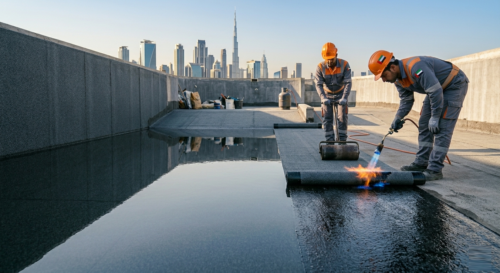
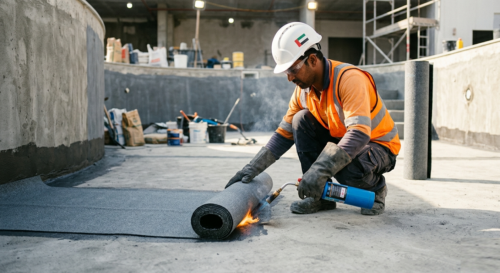
The gas torch is used to heat the bottom of the membrane during installation. The heat turns the changed bitumen into a liquid for a short period. When pressed onto the prepared substrate, it forms a chemical and mechanical bond that can only be broken by damaging the membrane itself. It works by plugging little holes in the surface and grabbing this job by the roots. As it cools, it sets up a waterproof barrier that won’t leak.
However, peel-and-stick self-adhesive membranes use a pressure-sensitive glue and are far more likely to come apart over time. The Torch app does help to reinforce the connection. There are no air holes glued underneath the membrane. No breaks in the glue. The barrier always goes from edge to edge.
The Two Types of Modified Bitumen Membrane: APP vs SBS
Knowing the difference between APP and SBS membranes is important to choosing the right product for the job. They both are used with the torch method, but they work differently and in different situations.
APP — Atactic Polypropylene
Modification of APP membranes with plastic polymers. They are quite firm at room temperature. When heated, the bitumen flows easily and adheres very well. APP membranes are harder and stiffer than SBS membranes when cooled down because they have a higher softening point. This means they don’t deform so easily at high temperatures.
APP is often the best choice, especially in Dubai. Surfaces can reach 70°C or more in direct sunlight, so you want a membrane that will not melt, blister, or flow when it gets hot. APP does a commendable job here. The APP cap sheets often have a surface finish made of mineral granules that is very resistant to UV light, which is critical in a market where the sun shines brightly all year.
SBS — Styrene-Butadiene-Styrene
SBS membranes have a rubber polymer stabilizer. They are more flexible than APP and can stretch further before breaking at room temperature. SBS membranes can be stretched and then recovered back to their original size. This makes them ideal for locations where structures need to move, such as bridge decks, podiums above occupied space, or structures with expansion joints.
SBS films are often used to waterproof the pool shell in Dubai because the concrete shell can move slightly as the ground settles or the water pressure changes with the seasons. That flexibility offers a safety cushion that stiffer membranes lack.
Thickness Grades and When Each Is Used
| 3mm Membrane | Light-duty applications, moderate foot traffic, used as base layer in multi-ply systems, internal walls |
| 4mm Membrane | Standard commercial and residential waterproofing, general rooftops, pool surrounds, podium decks |
| 5–6mm Membrane | Heavy-duty applications, high foot traffic areas, exposed rooftops, areas subject to mechanical stress |
| Multi-Ply Systems | Two or three layers combined for critical waterproofing zones—pool shells, rooftop terraces, underground tanks |
Where Torch Membrane Waterproofing Is Used in Dubai
There is no single answer for torch-membrane waterproofing. Those engineers and contractors with a wealth of experience know that this way of doing things is the best approach for certain jobs.
Swimming Pool Shells and Surrounds
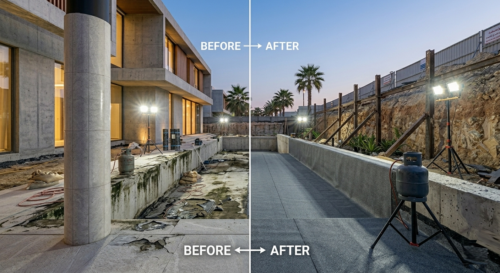
This type of seal is probably the hardest seal to do at home. The water in a swimming pool shell is treated with chlorine and other chemicals, which are very harsh on improperly made waterproofing materials. The pressure of water on the walls of the pool is always equal. Thermal expansion and contraction cycles constantly stress the sealing layer. The concrete shell is complete; we waterproof it at Green Creation by placing a fully connected torch membrane system on the top of the shell before any tiling takes place. The membrane wraps around pipe holes and layers at joints to protect the inside corners. No holes are visible. All the corners are closed off. This forms a waterproof layer that sits on top of the tiles and the grouting, which it does not affect. That way, even if the grout wears out over time, the waterproof barrier underneath will be in place.
Flat Rooftops and Roof Terraces
The torch membrane protection is the most widely used on flat roofs worldwide. Especially difficult to do in Dubai. It never rains, but it pours. If your flat roof isn’t draining properly, water can collect and get deep enough that cheap protection systems can’t handle it. It is cool in the morning. Then it is scorching in the afternoon and cool at night. This process means the waterproofing layer is always in motion. For torch membrane devices, this process is simple because they have a complete bond to the substrate. There is no way for the water to get between the membrane and the top, so even if a crack forms in the concrete below, the membrane will cover it so liquid can’t get below it.
Podium Decks and Landscaped Terraces
Podium decks, the elevated terraces you’ll find on many of Dubai’s residential and mixed-use towers, are built on top of occupied areas such as parking garages, shop units, and mechanical rooms. If the waterproofing cracks, the damage to the living space below is terrible. In this case, the best waterproofing systems are generally required. The solution is usually a multi-ply torch membrane with a protection board layer on top before the final layer of paving or grown landscaping is laid down.
Underground Structures: Basements and Below-Grade Tanks
In Dubai, the threat comes not from gravity pulling water down, but from hydrostatic pressure in the groundwater pushing inward. inward. The water table can be surprisingly shallow in areas close to the coast or in low-lying communities. Torch membrane waterproofing on the outside face of basement walls and underneath basement slabs can resist this hydrostatic pressure. The concrete is crucial here; the membrane must not only be impervious to water but also resist being pushed away from the surface by water pressure.
Wet Areas: Bathrooms, Plant Rooms, and Service Areas
The most common application for torch-applied membranes is waterproofing wet areas within buildings such as shower rooms, bathroom floors, plant rooms with drainage, and food prep areas in businesses prior to laying the floor and wall finishes. This prevents water from getting into the concrete slab and the adjacent rooms, which could be damaged by grout or broken tiles.
Green Roofs
As interest in environmentally friendly building design in Dubai continues to grow, so do green roofs — lawns planted on top of homes and businesses. These require protection to prevent water and roots from entering. If you are planning a planted roof, then there are particular torch-applied coverings with root-resistant additives that are worth mentioning for this job.
The Torch Membrane Waterproofing Installation Process: Step by Step
The quality of torch membranes depends a lot on the people who apply them. The stuff is great, but it needs to be used correctly to work as expected. How Green Creation does it.
Step 1 — Detailed Site Survey and Condition Assessment
We first check the substrate that will be waterproofed. We examine the concrete quality: surface finish, honeycombing, cracks, construction joints, penetrations for pipes and conduits, and the drainage configuration. Any structural defects are noted and repaired as necessary before waterproofing begins. If the substrate is not structurally sound, at some point the waterproofing system will fail.
Step 2 — Surface Preparation
The base must be clean, dry, and free of dirt, oil, residue from curing substances, loose particles, or standing water. Occasionally we clean the surface by hand. Cutting and treatment of protruding reinforcing bars. Cracks are filled with proper injections of cement or polyurethane. At the inside corners where the wall meets the floor, a mortar fillet or pre-formed fillet tape is used to smooth out the transition. This issue is due to the membrane being applied directly at a 90-degree angle and being under a lot of stress at that location.
Step 3 — Priming
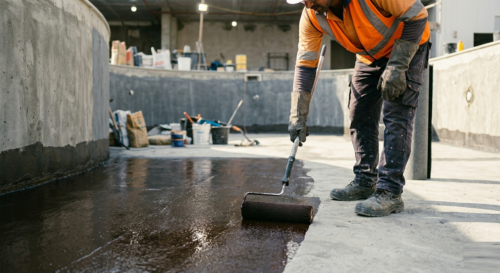
The prepared substrate is then primed with a bituminous primer at the recommended coverage rate (usually 4 to 6 square meters per liter). The primer penetrates the pores of the concrete and enhances the adhesion of the membrane. The primer also helps to consolidate any surface laitance. The primer needs to be completely dry before the membrane is fitted. In the hot weather of Dubai, the process takes on average one to two hours.
Step 4 — Detail Work and Reinforcement
We take care of all the details before the main field area is waterproofed—pipe penetrations, drainage outlets, upstand corners, movement joints, and termination points. These are the places responsible for the bulk of leaks in badly applied systems. Membrane reinforcement strips are used at all internal corners and pipe penetrations. Additional layers of membrane create a strong seal at these weak points. On pool projects we also do extra membrane reinforcement at all construction joints in the concrete shell.
Step 5 — Main Membrane Application
Then unroll, align, and roll up the membrane rolls again so they can be torched one by one in front of the roll. Once the bitumen is melted, the membrane is unrolled and rolled down into the base with a roller. Adjacent rolls shall overlap by at least 100 mm on lengthwise seams and 150 mm on end laps. They torch these gaps all the way through so the seam is completely fused and waterproof. The total fusion will be demonstrated by a continuous flow of molten bitumen from the leading edge of the overlap.
Step 6 — Upstand and Termination Details
Where necessary, the membrane shall be carried up the vertical face of upstands such as parapets, pool walls, and expansion joint upstands a minimum of 150 mm above the finished surface level. The top edge of the membrane is manually held in place and sealed with a suitable sealant or termination bar to prevent water from entering behind the membrane from above.
Step 7 — Quality Inspection and Flood Testing
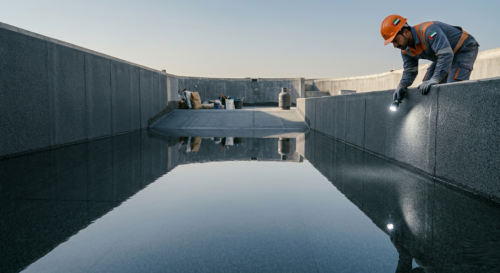
When the membrane is down, our site boss comes and inspects the finished product. We conduct flood testing on pool projects and any other job where waterproofing is needed, if possible. In this test, the area is filled with water to a depth of at least 50 mm and allowed to stand for 24 to 48 hours to see if water ingress is occurring. This is the only way to make sure it is waterproof before finishing on top of the membrane. Any problems found are resolved before passing the test.
Step 8 — Protection and Covering
On most applications, the finished membrane is protected before trades re-enter the area or before covering materials are applied. Protection boards (rigid foam or mineral wool) are often used on podium decks and pool surrounds. Pool shells are covered with cement screed before tiling. This protection prevents mechanical damage to the membrane during subsequent construction activities.
Why Dubai’s Climate Makes Torch Membrane the Right Choice
You can use other ways to waterproof. Sometimes, cementitioYou can use other ways to waterproof. IED systems are all useful. However, torch membrane is our primary method of use for most structural waterproofing jobs in Dubai. That’s the reason for it. There are other waterproofing methods that can be used. Sometimes, cementitious crystalline coats, EPDM sheet membranes, liquid-applied polyurethane membranes, and spray-applied systems are all useful. However, torch membrane is our primary method of use for most structural waterproofing jobs in Dubai. That is the reason.
Extreme Heat Performance
During summer, temperatures atop Dubai buildings can reach 70°C or more. Many liquid-applied membranes and normal bituminous products tend to become softer at these temperatures. This may cause them to flow over uneven surfaces or form blisters where they poorly bond to the base. To avoid this, APP-modified torch membranes with a higher breaking point are prepared. The mineral granule finish on the surface of the cap sheet reflects solar energy instead of absorbing it, which reduces the temperature of the surface.
Thermal Cycling Resistance
Even worse than high temperature is cycling, when building materials repeatedly expand and contract as they heat and cool over a 24-hour period. In a year a Dubai roof can go through thousands of these processes. They all put a lot of pressure on how well the waterproofing membrane sticks to the base. An SBS-modified torch membrane is flexible as rubber and can accommodate this movement without delaminating or cracking. That is why SBS is often chosen for pool shells and other places where the structure is expected to move.
UV Radiation Resilience
Dubai receives some of the most intense UV radiation in the world. If left to its own devices, the bituminous protection will oxidize and break down. APP-modified membranes finished with mineral granules are expected to be much more resistant to UV degradation than either unmodified bitumen or products with a smooth surface. When it comes to open applications such as rooftop patios without a covering layer, the choice of the right membrane finish is of critical importance.
Hydrostatic Pressure Resistance
The fully bonded torch membranes have a higher resistance to hydrostatic pressure than the loosely laid and partially bonded membranes due to the fact that they are mechanically anchored to the ground over their entire surface. This is crucial for pools and other below-grade uses. Because water pressure cannot get behind the membrane, it cannot expand, separate, or peel off the surface.
Chemical Resistance
Swimming pool water contains chlorine, chemicals that alter the pH, and algaecides. Many cheap sealing materials deteriorate when exposed to pool chemicals for long periods of time. Chemicals used to treat pool water don’t seem to damage torch-down modified bitumen very well, especially those reinforced with polyester. This is one of the reasons why torch membrane is often used as the primary protective layer under pool tiles in commercial pool building.
Signs That Your Waterproofing Has Failed — And What to Do
Not all homeowners need to start from square one. Many of our clients call us with a waterproofing job that has failed or is beginning to fail. Watch these things.
| Damp patches on ceilings or walls | Water is getting through the waterproofing layer above or adjacent. On flat roofs, this problem often appears directly below low points where water ponds. In pools, it appears on the outside of the shell, usually at construction joints or penetrations. |
| Blistering or bubbling of the membrane surface | ‘Blistering’ means moisture has become ‘trapped between the membrane and substrate, usually because the surface was damp when the membrane was applied or adhesion was incomplete. the membrane is away from the surface. |
| Cracking or splitting of the membrane | Surface cracking, particularly in a pattern that follows seam lines or corners, indicates that the membrane has become brittle — usually from UV degradation — or that there has been structural movement that exceeds the membrane’s elongation capacity. |
| Tile debonding in pools | Pool tiles that are lifting or hollow-sounding when tapped often indicate that water has penetrated behind the tile layer and is causing the adhesive mortar to fail. This in turn puts the waterproofing membrane at risk of direct chemical attack. |
| Rising damp on ground floor slabs | Where the underside of a slab has not been waterproofed against an upward hydrostatic head, moisture migrates through the concrete and causes damp patches, efflorescence (white crystalline salt deposits), and floor finish failure. |
If any of these things are true, then a professional check is the right thing to do. For existing pools and buildings we assess the state of the structure and waterproofing and advise frankly what needs to be done, whether it’s a localized repair, a complete re-waterproofing, or a structural repair and then new waterproofing. We don’t recommend work that isn’t needed.
How Long Does Torch Membrane Waterproofing Last?
A good modified bitumen torch membrane should last between 15 and 25 years if laid down properly on a suitably prepared base.
We have seen systems that were properly placed in protected areas (like pool shells under tiles or covered podium decks) last more than 25 years without any major issues.
Exposed uses are rooftop terraces without covering layers, which have shorter useful lives due to the constant UV and thermal cycling. Here you can expect the cap sheet to last 12 to 18 years before it begins to wear down on the surface and needs to be replaced or coated with something protected.
But when a membrane fails to last as long as it should, it’s rarely the material’s fault but rather the way it was applied. Things like non-sealed overlaps, undersized corners and penetrations, or, most importantly, moisture in the substrate at the time of application can all shorten its life. We researched many waterproofing failures, even though the material was fine and the job looked good from above. The problem was at the boundary between the substrate and the bonding material. There, moisture had caused blisters that eventually broke the bond from underneath.
And that’s why we assess the moisture of the substrate before application and won’t proceed if those results are too high. The contractor is skipping this step, keeping the project moving but setting the client up for failure. That’s not our way.
Why Green Creation Is the Best Torch Membrane Waterproofing Contractor in Dubai
We are going to be honest about this matter, as we always are. Many businesses in Dubai can install a torch barrier.m don’t have the depth that we do.
We understand the substrate before we touch it
Every sealing job starts with a thorough inspection of the situation. We check the concrete quality, water content, drainage setup, and structure features.procedure is the main difference between a good waterproofing job and a bad one.
Our people are trained specifically for this work
Sounds straightforward to put a torch membrane on. It is not. Correct settings for the torch temperature and application speed, full adhesion to the entire surface, proper sealing of gaps, and adding details around holes and corners are all skills that can only be learned by supervised practice. Our waterproofing teams have done this type of work a lot of times. They can tell the difference between a good bond and a bond that looks good but isn’t solid.
We specify the right system for each application
We don’t always use the same membrane. We select APP or SBS, 3 mm or 4 mm, multi-ply or smooth finish, and mineral powder or APP, according to the needs of the job. The waterproofing needs of a swimming pool shell are different than for a rooftop patio. These decisions are based on what we know about building, not on what products are available.
We use quality-proven materials
The companies that supply us with membranes are established brands with a history of working well in the temperature of the Middle East. We don’t buy the cheapest thing that meets the requirements, per se. When you consider the cost of the whole project, the difference in material cost between a good membrane and a subpar one is not that large. Using a poor barrier can create many problems.
We flood test. Always.
We will not provide you a finished pool or essential waterproofing job until we have checked it for flooding. If we can’t test an area by soaking it, we do other checks, like taking readings on the moisture level, finding it during the holiday season, or monitoring it for longer periods. The test is not a formality. But eventually it’s the proof of the work done right that matters.
Our waterproofing is part of a total project capability
The majority of companies that seal only seal. We build or repair the pool or structure, waterproof it, tile it, plant around it, and maintain it. When waterproofing is included in a full construction package from the same team, the links between building tasks are well taken care of. Does the waterproofing contractor ever blame the structure contractor for problems with the substrate, or does the tiling contractor ever blame the waterproofer for problems with adhesion? Everyone is involved. We understand the right start.
We are transparent about what is needed
We will let you know if a small repair can fix a moisture issue. “Sometimes we don’t recommend full re-waterproofing if it’s not necessary. We pride ourselves on building long-term relationships with our clients, not on squeezing the most out of each job.
Torch Membrane vs Other Waterproofing Methods: An Honest Comparison
| Torch Membrane Waterproofing | Fully bonded, seamless, excellent hydrostatic resistance, high UV and heat tolerance (APP), flexible (SBS), 15–25 year lifespan, preferred for pools, roofs, and podiums |
| Liquid Polyurethane (PU) Coating | Good flexibility, easier to apply on complex shapes, lower hydrostatic resistance, suitable for wet areas and balconies, shorter lifespan in UV exposure (8–12 years typically) |
| Cementitious / Crystalline Coating | Bonds into concrete matrix, good for negative-side waterproofing, limited flexibility, not suitable where movement is expected, used in tanks and basements |
| Self-Adhesive Membrane | Easier application, no flame required, lower bond strength than torch-applied, more susceptible to delamination over time, suitable for lower-risk applications |
| EPDM Sheet Membrane | Very long lifespan, excellent UV resistance, loosely laid systems can allow water to travel under if punctured, requires careful detailing, more common in cool climates |
| GRP (Fibreglass) Lining | Excellent for pool renovation and repair, rigid, not suitable where structural movement is expected, more expensive per m² than torch membrane |
For most structural waterproofing applications in Dubai—swimming pools, rooftops, podiums, and basements—the system that consistently performs best for the money is the torch membrane. It’s not always the cheapest option upfront. It is almost always the cheapest option over the lifetime of the building.
Frequently Asked Questions About Torch Membrane Waterproofing in Dubai
Q: How much does torch membrane waterproofing cost in Dubai?
A: The costs will vary depending on the use, the size of the surface, the number of layers, and the preparation of the surface. The average price for torch membrane waterproofing in Dubai is AED 45 to AED 120 per square meter, including both the product and labor costs. Waterproofing the pool cover, which requires more work around holes and corners, is usually the most expensive part of this range. We provide detailed, clear quotes after we look at the site; we won’t give you an exact quote until we see what the surface really looks like.
Q: How long does the application take?
A: If the substrate is properly prepared, a professional team can complete the work in one to two days on a typical residential roof of 100 to 150 square meters. Waterproofing a typical residential pool shell is a two- to three-day process that includes preparation of the substrate, detailing, and flood checking of the pool.
Q: Can torch membrane be applied in Dubai’s summer heat?
A: The application should be done when ambient temperatures are manageable — typically early morning. High substrate surface temperatures (>60°C) make consistent membrane adhesion very difficult and increase the risk of blistering. Practically speaking, it means planning waterproofing work for the cooler months, where possible, or working early shifts in the summer. So we program accordingly.
Q: Does torch membrane waterproofing require maintenance?
A: Uncovered roofs with exposed torch membranes should be checked annually for debris that may hold water or damage the membrane. If a protected membrane is used under tiles, screed, or paving, it needs no more care than the covering layer. For important areas such as pool shells and basement walls, we recommend a waterproofing checkup every five years.
Q: Is torch membrane waterproofing safe to use near existing structures?
A: Proper management of the open flame is needed when using a torch, especially when working near flammable materials, existing membrane flashings, or occupied areas below. Our teams are trained in the safe use of flares. The spot is properly prepared before the torching begins, and heat shields are used where necessary. We do waterproofing work only that obeys the rules set by the Dubai Municipality and international safety standards.
Q: Can Green Creation repair an existing torch membrane that has failed?
A: Yes. We rectify small problems and re-waterproof systems that have already failed. The method depends on the degree of failure and the root cause of that failure. This we verify during a site visit before we make any proposals. If it is the right thing to do, we will propose a local fix.
Get It Right the First Time
Waterproofing is a construction issue that people often think about only when it goes wrong. A well-waterproofed structure is unnoticeable, maintenance-free, and utterly unremarkable. Failed waterproofing systems are disruptive and expensive and can damage the structure itself when a swimming pool or a roof over occupied space is involved.
The first result of using quality materials comes from experienced people who perform proper torch membrane waterproofing. This is the system we trust for our pool builds and the system we recommend without hesitation for rooftops, podiums, basements, and wet areas throughout Dubai.
If you’re thinking of a new pool or construction project and want to ensure your waterproofing is right for the life of the structure, talk to us. Do you have an existing structure showing signs of waterproofing failure? Talk to us. We will look at it honestly, tell you what the real issue is, and give you a clear recommendation.
Green Creation – www.green-creation.com – has been doing this in Dubai for over twenty years. We are not going anywhere, and neither is our work.
Call / WhatsApp: ☎ +971 50 948 4081
Email: info@green-creation.com